Technology
Home > Technology > BTO-22 vs CBT-65: Which Razor Wire Wins?
Compare BTO-22 vs CBT-65 concertina razor wire
Ask ten fence suppliers which razor wire they sell most, and the answer comes back the same: BTO-22. Then ask which one they'd put on their own perimeter, and a surprising number will name CBT-65.
Both are concertina razor wire. Both are galvanized. Both exist for one purpose — stopping people from climbing over. Yet they are not interchangeable. Choose wrong and you either pay for more deterrence than the site needs, or install something that won't hold up where it matters.
This guide breaks down the real differences between BTO-22 and CBT-65: blade design, dimensions, security performance, cost, and the applications each one suits. If you're sourcing for a project, you'll have a clear answer by the last section.
What Are BTO-22 and CBT-65?
Both types are concertina razor wire — coils of steel wire carrying sharp blades, compressed flat for shipping and expanded on site like an accordion. The number in the name tells you which blade geometry you're getting.
BTO-22 is the global workhorse. The "22" refers to the blade width of 22 mm, and the blade itself is a butterfly profile — the steel strip is stamped and curved outward on both sides, giving the coil a dense, aggressive look. Core wire is typically 2.5 mm with a steel strip thickness around 0.5 mm.

CBT-65 is the heavy option. The "65" refers to a 65 mm blade length, and the profile is straight rather than curved. The blade is cut longer and the steel strip is substantially thicker — around 1.2 mm versus 0.5 mm on BTO-22 — which makes each blade noticeably stiffer and harder to bend or crush.
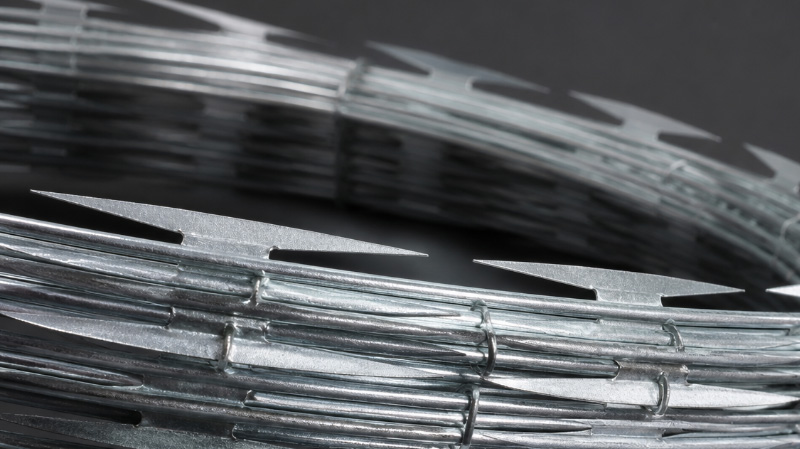
Both use low-carbon steel wire, and both can be supplied electro galvanized or hot-dipped galvanized. Both collapse into standard coil diameters — commonly 450 mm, 500 mm, or 700 mm — and expand on site to a coverage width you specify by the number of rings per coil.
BTO-22 vs CBT-65: Key Differences at a Glance
Here's the comparison table we give buyers who ask this exact question. Note that figures are typical values — they vary slightly between factories, so always confirm the data sheet before ordering.
| Feature | BTO-22 | CBT-65 |
|---|---|---|
| Blade profile | Butterfly (curved) | Straight, long |
| Blade width | 22 mm | ~21 mm |
| Blade length | ~65 mm | 65 mm |
| Steel strip thickness | ~0.5 mm | ~1.2 mm |
| Core wire diameter | 2.5 mm | 2.5 mm |
| Common coil diameters | 450 / 500 / 700 mm | 500 / 700 / 960 mm |
| Typical weight per coil | ~11.5 kg | ~13 kg |
| Typical expanded length | 10–12 m per coil | 11–15 m per coil |
| Deterrence style | Dense, layered | Heavy, sharp |
| Relative cost | Lower per meter | Higher per meter |
Blade Design: Dense vs Heavy
The blade profile changes how the wire behaves more than the numbers suggest. BTO-22's curved butterfly blades fan out on both sides of the core wire, so every ring of the coil presents several rows of barbs in different directions. Climbing it means finding a grip among dozens of angled blades — slow, painful, and visually obvious from a distance.
CBT-65's straight blades are longer and thicker but point in a more uniform direction. There are fewer blades per ring, yet each one is heavier and sharper-edged. It's less about density and more about individual blade strength.
Materials and Durability
Same core wire, very different strip thickness. That 1.2 mm strip on CBT-65 resists bending tools and corrosion damage far better than the 0.5 mm strip on BTO-22. If blades are likely to be attacked, cut, or exposed to harsh coastal weather for years, the thicker steel gives CBT-65 a real durability edge.
Which One Deters Better?

"Better" depends on the threat you're defending against.
For visual deterrence and climb resistance, BTO-22 wins. The butterfly profile creates a denser, more intimidating barrier. This is why prisons, military compounds, and high-security perimeters overwhelmingly specify BTO-22 (often in double coils) — the goal there is to make intrusion look impossible before anyone tries.
For physical resistance to tools and long-term abuse, CBT-65 has the edge. Thicker blades are harder to flatten with a hammer or pry through with pliers. Sites where intrusion attempts are likely — not just discouraged — tend to favor the heavier blade.
In practice, the most security-conscious projects don't choose between them at all. They run BTO-22 as the primary coil and add a CBT-65 coil above it, or alternate the two along the fence line. That combination layers density with blade strength.
Cost and Practical Considerations
BTO-22 is the cheaper option — roughly 15–30% less per meter than CBT-65, depending on coil diameter and galvanizing method. Because it's produced in higher volumes, lead times are shorter and more factories stock it.
CBT-65's higher price buys thicker steel and a heavier blade, and it shows up in freight too. Coils are bulkier and heavier, so container utilization drops slightly compared to an equivalent BTO-22 order.
When you calculate cost, don't compare per coil — compare per meter of covered fence line. Two coils of the same diameter don't necessarily cover the same length once expanded. Ask the supplier for the expanded length per coil and the recommended rings per coil for your fence height, then work out the true cost per meter of coverage.
Here's a quick example. A 400-meter fence line with each coil expanded to cover 1.5 meters of fence needs about 267 meters of expanded coil. At 12 meters per coil, that's roughly 22 coils — plus 5–10% for overlaps, joins, and corners, which brings the order to 23–24 coils. A supplier who can't tell you the expanded length per coil can't help you get this number right, and that's a useful test in itself.
Common Mistakes Buyers Make
After years of quoting razor wire projects, we see the same handful of errors come up repeatedly. Skip these and you'll avoid the most expensive lessons:
- Comparing per-coil prices instead of per-meter coverage. The cheapest coil on paper can be the most expensive fence line in practice if it covers less.
- Forgetting overlaps and corners. Coils don't butt together cleanly; every join needs overlap, and corners consume extra. Buy 5–10% more than the straight-line math suggests.
- Using electro galvanized wire on a coastal site. Salt air eats thin zinc fast. Pay the premium for hot-dipped and sleep better.
- Assuming blade thickness is the same across types. The gap between 0.5 mm and 1.2 mm strip steel is the difference between a deterrent and a serious obstacle.
- Ordering accessories last. Clips, brackets, and spiral supports are cheap — but they hold up the whole installation if they don't match the coil diameter or arrive late.
- Skipping samples. A meter of sample coil tells you about blade sharpness, zinc coverage, and weld quality in five minutes. It costs almost nothing.
Which Should You Choose? A Scenario Guide
| Situation | Recommendation |
|---|---|
| Prison, military, or high-security perimeter | BTO-22, double coil |
| Factory, warehouse, or general industrial site | BTO-22, single coil — best value |
| Coastal area or aggressive corrosion environment | CBT-65 hot-dipped, or BTO-22 hot-dipped |
| Site with a history of attempted intrusions | CBT-65, or BTO-22 + CBT-65 combined |
| Upgrading an existing fence line | BTO-22 single coil on top of the existing barrier |
| Budget-driven project with standard deterrence needs | BTO-22 |
One more consideration: local regulations. Some regions restrict razor wire on public-facing boundaries or require minimum mounting heights. Check the rules for your site before committing to a type — it can save you from replacing an entire fence run.
What to Specify When Ordering
Once you've picked the type, don't stop at "BTO-22" or "CBT-65." A complete inquiry covers eight points:
- Type and blade profile — BTO-22 butterfly or CBT-65 straight
- Coil diameter — 450 mm, 500 mm, 700 mm, or other
- Rings per coil and expanded length — this drives your quantity calculation
- Galvanizing method — electro or hot-dipped; hot-dipped for outdoor and coastal use
- Blade and core wire dimensions — confirm against the factory data sheet
- Fixing accessories — clips, brackets, and spiral supports, and whether they're included
- Standards and certificates — ask whether the zinc coating meets the relevant standard (for example, the ASTM specification covering zinc-coated steel wire) and request test certificates
- Samples — a short coil sample costs little and tells you more than any data sheet about blade sharpness and build quality
Send the same spec to two or three manufacturers and compare the answers side by side. The supplier that comes back with precise numbers — not just "no problem" — is the one to trust with the order.
Conclusion
So which razor wire wins? It depends on what you're defending. BTO-22 is the dense, economical, visually intimidating standard that suits most sites — and the right answer for the majority of buyers. CBT-65 is the heavier, harder-wearing option for sites where blades will be tested rather than just looked at. Neither is "better" in absolute terms; they're built for different jobs.
Write down your site conditions, threat level, and budget before you ask for quotes. Then compare specs per meter of coverage, request samples, and verify the galvanizing. Get those basics right and either type will do its job for years.
- Galvanized Barbed wire fence stay
- Galvanized Barbed Wire
- PVC Coated Barbed Wire
- Barbed Wire Fence
- Barbed Wire Machine
- Barbed Wire Twist Types
- High Tensile Steel Barbed Wire
- Concertina Barbed Wire
- Razor Wire Mobile Security Barrier
- Galvanized Razor Wire
- Galvanized Concertina Wire Fence
- Razor Wire Fence
- Single Concertina Wire
- Hot-dipped Galvanized Razor Wire
- Cross Razor Wire
- Straight Type Razor Wire
- Welded Razor Wire Fence
- Concertina Wire
- Flat Razor Wire Fence
- Ground Locking Pegs
- Razor Wire Machine