Technology
Home > Technology > Barbed Wire Fence: Types, Specifications, and a Complete Buying Guide
Compare galvanized, PVC coated, and high tensile barbed wire
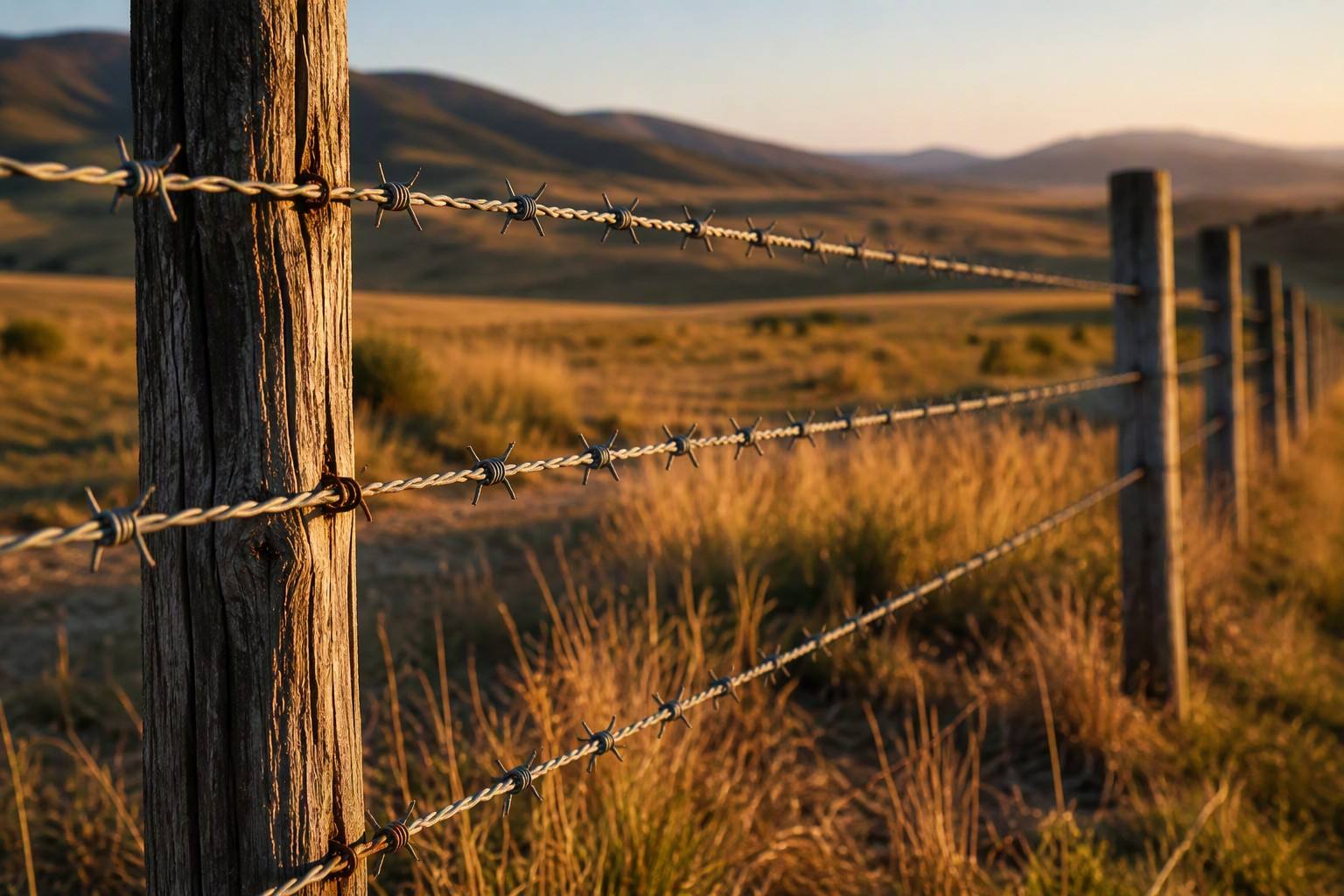
A procurement manager once asked us why some barbed wire rolls last fifteen years while others rust out in three. It's a good question, and the answer has less to do with price than with specification. Barbed wire looks simple — two twisted strands, a few sharp points — but the steel grade, the coating, and the way the wire is manufactured determine whether your fence is a five-year fix or a twenty-year asset.
This guide covers the barbed wire types available today, the specifications that actually decide performance, and what to check before placing a bulk order. Whether you're fencing cattle range, securing a plant perimeter, or reselling to contractors, the detail below will keep you from paying for the wrong product.
What Is Barbed Wire, and How Is It Made?

Barbed wire is fencing wire with sharp points spaced at regular intervals along its length. The classic construction uses two line wires twisted together, with barbs wrapped around one or both strands. Single-strand versions, where barbs are crimped or wrapped around one line wire, are also common for lighter duty.
Production starts with steel wire rod, typically low-carbon or high-tensile grade. The rod is drawn down to the required diameter, then galvanized — either hot-dipped or electroplated — to protect the steel from corrosion. On a barbed wire machine, line wires are fed and twisted while a separate spool of barb wire is cut, pointed, and wrapped around the line wires at a preset spacing. A typical machine outputs around 70 kg per hour, and a single production line can run 20–30 tons a month. Quality production is about consistency: uniform twist, even barb spacing, and a coating that survives bending without flaking.
Twist types
- Single twist — one line wire with barbs wrapped around it. Light and economical, used where loads are modest.
- Double twist — two line wires twisted together. This is the standard construction for agricultural and boundary fencing; it holds tension better over long post runs.
- Traditional twist — the older two-strand style, still specified for certain regional and heritage fencing.
Barb spacing typically runs from 3 to 6 inches (75–150 mm), with 2-point and 4-point barb configurations. Four-point barbs are the standard for security applications — they deter no matter how the wire is approached. Two-point versions are common for livestock, where a lighter profile means fewer animal injuries.
The Main Types of Barbed Wire
Galvanized barbed wire
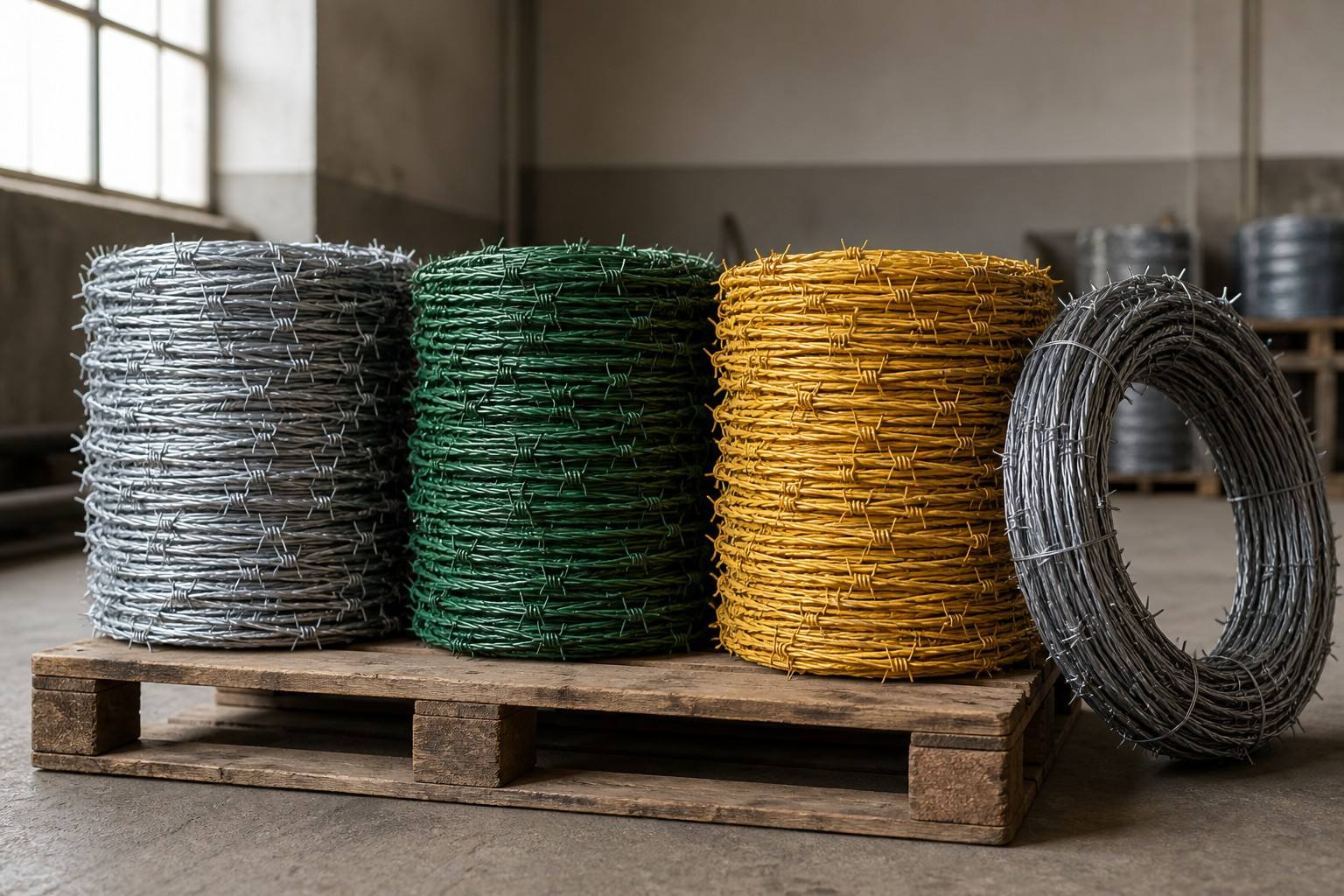
Galvanized barbed wire is the industry workhorse, and you'll meet two coating classes. Electro-galvanized wire carries a thin zinc layer and the lowest price. Hot-dipped galvanized wire carries a much heavier coating — commonly 80–275 g/m² — and lasts three to five times longer in outdoor service. For permanent fencing in wet or coastal regions, hot-dip is almost always the right call. A typical specification: 2.8 mm line wire, 2.0 mm barb wire, packed 25–45 kg per coil.
PVC coated barbed wire
PVC coated barbed wire wraps a galvanized core in a plastic layer, adding corrosion resistance plus color options — green and yellow are the most requested for rural and highway settings. The coating also softens the fence for livestock and reduces wear. Standard construction: galvanized inner wire of 1.6–3.5 mm, coated outer diameter of 2.0–4.0 mm, with coil lengths from 50 to 400 meters. In high-UV or high-humidity regions, a quality PVC layer can extend fence life five to ten years beyond bare galvanized.
High tensile barbed wire
High tensile barbed wire uses a stronger steel grade, so a thinner wire carries the same or better load. A typical spec reads: 3.7 mm wire, tensile strength around 1235 N/mm², galvanized coating of 275 g/m². The economics are the real selling point. High tensile wire allows post spacing up to 20 meters on flat ground, which slashes post and labor costs on large landholdings. The trade-off: it's stiff, harder to handle, and needs proper tensioning tools during installation.
Concertina barbed wire and razor wire
Concertina barbed wire is barbed wire formed into a coiled, expanding spiral, usually mounted on top of chain link or welded mesh for high-security perimeters — airports, prisons, military sites, and utility installations. Razor wire, made from steel strip with sharp blades, is a separate family with higher deterrence. Don't confuse the two when planning a perimeter: barbed types are a deterrent and a psychological barrier, while razor types are a physical barrier that's genuinely hard to cross.
Specifications That Matter When Ordering
| Specification | Galvanized | PVC coated | High tensile |
|---|---|---|---|
| Line wire diameter | 2.0–3.0 mm | 1.6–3.5 mm core | 2.5–3.7 mm |
| Barb wire diameter | 1.5–2.0 mm | 1.4–2.0 mm | 2.0 mm |
| Tensile strength | 350–550 N/mm² | 350–550 N/mm² | 900–1250 N/mm² |
| Coating | Zinc 40–275 g/m² | Zinc + PVC | Zinc 275 g/m² |
| Barb spacing | 75–150 mm | 65–120 mm | 75–150 mm |
| Typical coil/roll | 25–50 kg | 50–400 m | 25–50 kg |
Five checks before you order:
- Wire diameter — thicker is stronger, but heavier and pricier. Match it to the load, not to habit.
- Zinc coating weight — the single biggest predictor of service life. The gap between 40 g/m² and 275 g/m² is roughly a decade of rust protection.
- Tensile strength — this decides post spacing and how long the fence holds tension. High tensile wire (900+ N/mm²) is a different product from soft wire, not just a marketing label.
- Barb spacing and point count — 2-point for livestock, 4-point for security. Confirm it in the spec, because it's easy to miss in a photo.
- Coil weight and length — standard coils run 25–50 kg; PVC rolls run 50–400 m. Know your units before quoting freight and installation.
Manufacturers commonly produce barbed wire to ASTM A121 (zinc-coated steel barbed wire) and comparable BS and JIS wire standards. Ask which standard the product is made to — a supplier who can state it in writing has control of the process; one who can't is probably quoting you an off-spec product.
Where Barbed Wire Is Used
- Agriculture and ranching — the classic application: containing cattle, sheep, and horses over large acreage where cost per meter has to stay low.
- Security perimeters — industrial plants, warehouses, utility substations, and military facilities top existing fencing with barbed or razor wire.
- Transportation — highway rights-of-way, railway corridors, and airport perimeters.
- Mining and energy — site boundaries at mines, oil fields, and wind farms, where fencing must survive harsh climate and resist intrusion.
- Boundary and residential use — masonry walls and chain link fences in many markets get an economical deterrent layer from a few lines of barbed wire.
Each application changes the buying math. A ranch on 500 acres measures value in cents per meter; a warehouse in a high-crime district measures value in deterrence and insurance premiums. Know which side of that equation you're on before you compare prices.
How to Choose the Right Barbed Wire for Your Project
Work through these in order:
- Define the threat level. Livestock containment and perimeter security are different jobs. Deterrence calls for 4-point barbs and heavier gauge; livestock calls for 2-point barbs and lighter tension so animals don't get cut.
- Match the climate. Coastal, humid, and industrial environments demand hot-dip galvanizing or PVC coating. Dry inland regions can use electro-galvanized wire at lower cost.
- Compute installed cost, not material cost. High tensile wire costs more per roll but permits wider post spacing — on a 10 km boundary, that difference can save thousands in posts and labor. A four-line fence with standard spacing runs roughly 300 mm between lines and stands about 1.2 m; high tensile versions can stretch post spacing to 15–20 m on flat ground.
- Confirm the specification in writing. "Galvanized" alone is not a spec. Require zinc coating weight (g/m²), wire diameter, tensile strength, barb spacing, and coil weight on the order sheet.
- Check packaging and logistics. Coils must be tightly wound and banded for container shipment; loose or damaged coils cause tangling on site. Confirm net weight per coil and total container loading before booking freight.
What to check on a sample
Before a bulk order, request samples and run three quick checks. Barbs should be sharp and evenly spaced. The twist should be uniform, with no broken or kinked strands. And the coating should not flake or crack when the wire is bent through 90 degrees. These three checks catch most quality problems at the sample stage — before you're stuck with a container of the wrong product.
Market Insights: Sourcing Barbed Wire from China
China is the world's largest production base for barbed wire, with manufacturing concentrated in Hebei province — home to hundreds of wire and mesh factories shipping galvanized, PVC coated, and high tensile barbed wire to the Middle East, Africa, Latin America, and Southeast Asia. For international buyers, the advantages are mature capacity, flexible customization (barb spacing, coil size, PVC colors, packaging, labeling), and container-based pricing that keeps the unit cost low on volume orders. A 20-foot container typically holds 15–22 tons of barbed wire, depending on wire diameter and coil weight.
Current market quotes for galvanized barbed wire commonly sit in the range of roughly $0.10–0.30 per meter depending on gauge, coating class, and order volume, with per-ton pricing varying as steel and zinc costs move. The practical takeaway: fix your specification first, ask for pricing with a validity period, and request quotes for both electro and hot-dip options. Comparing service life per dollar beats comparing price per ton every time.
Frequently Asked Questions
How long does galvanized barbed wire last? Electro-galvanized wire typically serves 3–5 years in outdoor exposure; hot-dipped galvanized wire (275 g/m²) commonly lasts 15–20 years. PVC coating on top of hot-dip extends that further.
What gauge barbed wire should I use for cattle? 12.5 gauge (about 2.5 mm) low-carbon wire with 2-point barbs is the long-standing standard for cattle fencing; 15.5 gauge high tensile is the modern choice where post spacing needs to be wider.
What's the difference between barbed wire and razor wire? Barbed wire uses twisted wire with points — a deterrent that's low-cost and common. Razor wire uses sharp steel blades and is a physical barrier for high-security sites. They're often combined: barbed wire lines on top of chain link, with razor wire above for critical perimeters.
How many meters are in a roll of barbed wire? Coil weights run 25–50 kg for standard galvanized product; PVC coated rolls are quoted by length, typically 50–400 meters. At 2.8 mm line wire, a 25 kg coil is roughly 200 meters.
Can barbed wire be recycled? Yes. Steel barbed wire is fully recyclable as scrap, and the zinc coating is recovered during steel recycling. This is a growing consideration for buyers with ESG reporting requirements.
Conclusion
Barbed wire is still the most cost-effective fencing material for large perimeters, and everything that decides its lifespan — zinc coating weight, wire diameter, tensile strength, and coating type — is visible on a spec sheet before you commit. Choose by climate and threat level, get the specification in writing, and check samples before you order in bulk.
If you're planning a purchase, send us your fence length, terrain, and intended use. We'll recommend the right gauge and coating, and back it with a written specification and a container-loading plan.
- Galvanized Barbed wire fence stay
- Galvanized Barbed Wire
- PVC Coated Barbed Wire
- Barbed Wire Fence
- Barbed Wire Machine
- Barbed Wire Twist Types
- High Tensile Steel Barbed Wire
- Concertina Barbed Wire
- Razor Wire Mobile Security Barrier
- Galvanized Razor Wire
- Galvanized Concertina Wire Fence
- Razor Wire Fence
- Single Concertina Wire
- Hot-dipped Galvanized Razor Wire
- Cross Razor Wire
- Straight Type Razor Wire
- Welded Razor Wire Fence
- Concertina Wire
- Flat Razor Wire Fence
- Ground Locking Pegs
- Razor Wire Machine